01 Know thy inner saga

Which Norse God Are You? A Norse Mythology Personality Quiz

Which gods shape your spirit?

You are not one archetype. You are a living constellation—part seeker, protector, lover, trickster, and judge. Answer six questions to map the Norse forces moving within you.

A bare rune-stone, waiting. Nothing is written here until the ritual begins.

The codex below The codex — sealed

02 The ritual

Six questions, five gods, one constellation

Each scene is drawn from a pool of twelve. Answer by instinct—every choice is quietly sworn to one god. When the sixth rune falls you receive your blend of Odin, Thor, Freyja, Loki and Tyr, led by your dominant god.

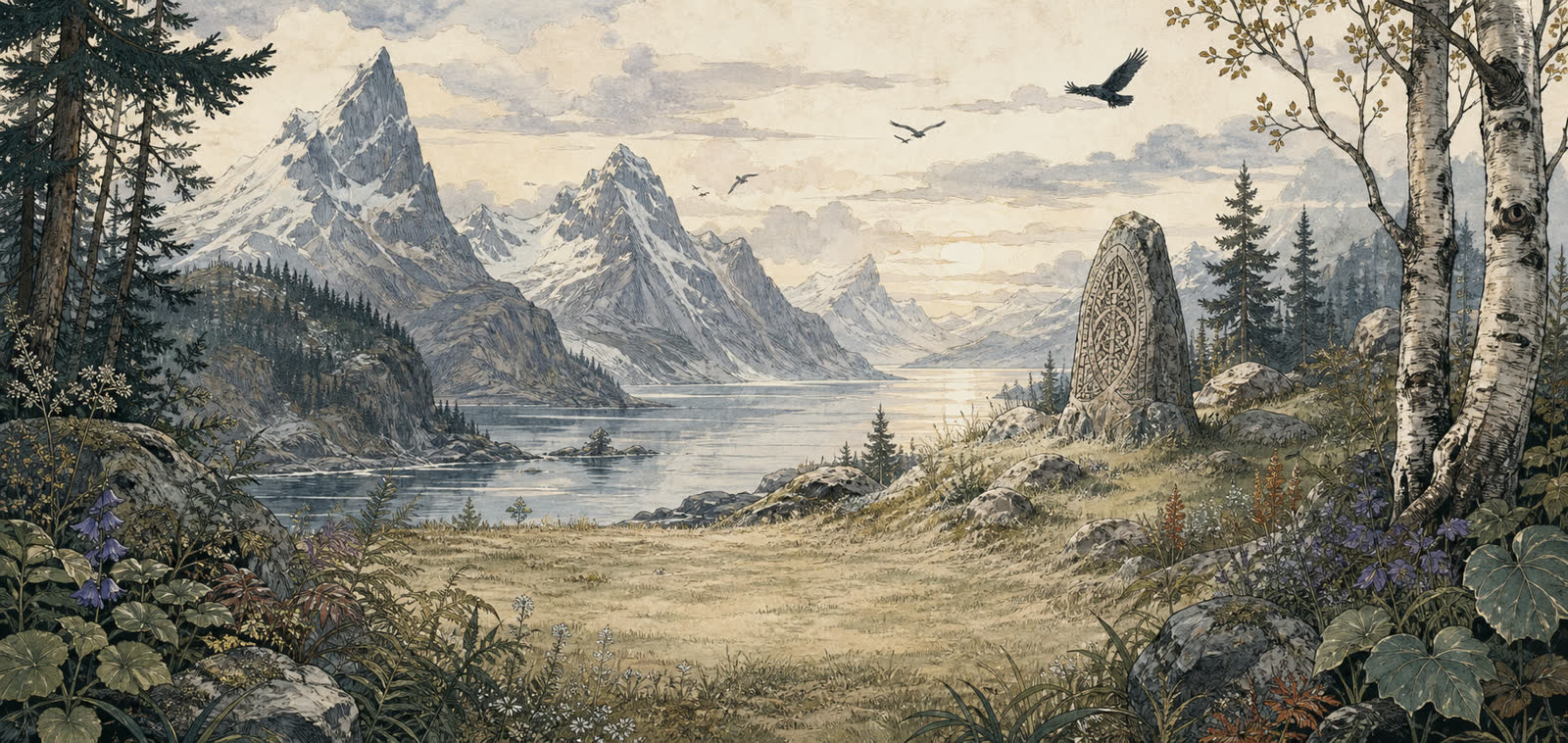
Illustrated Norse landscape: a rune-carved standing stone above a mountain fjord, ravens circling snow-capped peaks
The road between worlds—every ritual crosses it.

03 The five archetypes

An illuminated codex of the self

Five gods, five orientations of the spirit. Read your dominant chapter first—then the one you scored lowest, which usually knows you better than you would like.

Chapter IThe Seeker

Odin: The Seeker Archetype in Norse Mythology

Odin is not what most people expect. He is not primarily a god of war or power — he is a god of relentless seeking: of knowledge, wisdom, understanding things that cannot be understood without cost.

He sacrificed one eye to drink from Mimir's well. He hung from Yggdrasil for nine days and nights to receive the runes. He sends his ravens Huginn (Thought) and Muninn (Memory) out each morning to witness the nine worlds.

Everything Odin does is in service of knowing more.

The Psychology of the Seeker

The Seeker is the figure who cannot be content with the world as it is, who must press further, know deeper, understand more fully. The cost is well understood — it pulls the Seeker away from comfort, from stability, from belonging.

Odin's relationships are famously complicated. His ultimate loyalty is to understanding — not to individuals, not even to outcomes.

Are You an Odin Type?

The Odin archetype resonates with people who:

  • lead with curiosity before emotion;
  • feel most alive when learning something genuinely new;
  • find social belonging slightly effortful;
  • carry a persistent sense that there is something important they have not yet understood.
Find Out If You're an Odin Type →

Chapter IIThe Protector

Thor: The Protector Archetype in Norse Mythology

Thor is the most beloved Norse god — not because he is the wisest or the most powerful, but because he is the most straightforwardly good. He fights monsters. He defends the innocent. He is exactly what he appears to be.

Who Is Thor?

Son of Odin and the earth goddess Jörð. God of thunder, storms, and strength — and the protector of Midgard (the human world). His hammer Mjölnir can level mountains and returns to his hand after being thrown. During the Viking Age, Mjölnir pendants were worn as protective amulets across Scandinavia.

The Psychology of the Protector

The Protector archetype is defined not by dominance but by orientation: toward others. The Protector's strength is always in service of something beyond themselves. They don't need to calculate. When something is wrong, they respond.

The Protector's shadow is overreach — the drive to protect can become the drive to control.

Are You a Thor Type?

The Thor archetype resonates with people who:

  • feel instinctively responsible for those around them;
  • act before they think in situations involving threat or injustice;
  • are reliably present in a crisis.
Find Out If You're a Thor Type →

Chapter IIIThe Enchanter

Freyja: Love, War and the Enchanter Archetype

Freyja is frequently reduced to a goddess of love and beauty — which misses the full picture considerably. She is also a goddess of war and death. She chooses half of those who fall in battle. She is a master of seiðr magic, which she taught to Odin himself.

Who Is Freyja?

A member of the Vanir — an older tribe associated with fertility, prosperity, and magic — who came to live among the Aesir. Her husband Óðr is perpetually absent — she travels the nine worlds searching for him, weeping tears of gold. Her most famous possession: the Brísingamen necklace.

She is sought after, desired, and sometimes threatened by giants who want to possess her. She is never possessed.

The Psychology of the Enchanter

The Enchanter archetype is about the capacity to draw others into one's orbit through presence, depth, and a magnetism that operates below rational understanding. The Enchanter moves through the world by attraction rather than force.

Are You a Freyja Type?

The Freyja archetype shows up in people who:

  • are intensely affected by beauty in all its forms;
  • feel emotions with overwhelming depth;
  • have a natural capacity to draw others toward them almost effortlessly.
Find Out If You're a Freyja Type →

Chapter IVThe Shapeshifter

Loki: The Trickster — Norse Mythology's Most Complex God

Loki is the character everyone finds most interesting — and the hardest to categorise. He is neither fully a god nor fully a giant. Neither hero nor villain. He is the force in the Norse cosmos that refuses to hold still long enough to be understood.

Who Is Loki?

A shapeshifter accepted among the Aesir gods despite being a giant's son. He helps them repeatedly — often cleaning up messes he created. His offspring include Fenrir (the wolf), Jörmungandr (the world serpent), and Sleipnir (Odin's eight-legged horse — Loki was the mother).

Then he orchestrated the death of Baldr, the beloved son of Odin. The gods bound him beneath the earth until Ragnarök.

The Psychology of the Trickster

Present in virtually every mythology. What they share: the capacity to operate outside the rules, to see the gaps in every system. Every stable system eventually calcifies. The Trickster is the force that breaks things open — not from nihilism, but from a constitutional inability to accept the current arrangement as final.

Are You a Loki Type?

The Loki archetype shows up in people who:

  • see through social pretension immediately;
  • find rules interesting primarily as things to test;
  • are often the most entertaining person in the room — and also the most exhausting.
Find Out If You're a Loki Type →

Chapter VThe Just

Tyr: The Judge — Norse Mythology's God of Justice

Tyr is perhaps the one who speaks most directly to a particular kind of moral courage that is genuinely rare. He is the god of justice, law, and righteous judgment. He is the god who sacrificed his hand.

The Story of Tyr's Sacrifice

The wolf Fenrir was growing to monstrous size. The gods needed to bind him. They commissioned the dwarves to create Gleipnir — a magical ribbon, thin as silk but unbreakable. Fenrir agreed to be bound, but only if one god placed a hand in his mouth as a pledge.

No god was willing — except Tyr. He placed his hand in Fenrir's jaws. The gods bound the wolf. Fenrir bit off Tyr's hand.

Tyr knew this would happen. He placed his hand there anyway.

The Psychology of the Judge

The Judge archetype is about an internal commitment to what is right that operates independently of personal cost. The Judge can see clearly what a situation requires — and act on that clarity even when it is painful.

Are You a Tyr Type?

The Tyr archetype shows up in people who:

  • feel a strong internal compass that does not require external validation;
  • are willing to take a stand even when it costs them personally;
  • are not easily manipulated by emotional appeals.
Find Out If You're a Tyr Type →

04 The saga, read whole

The 5 Norse God Archetypes: Which One Are You?

Norse mythology contains a remarkably sophisticated map of human psychology. The gods represent distinct fundamental orientations — not personalities in a simple sense, but ways of being in the world.

  • Odin — The Seeker: Relentless curiosity at any cost. Most alive when learning something genuinely new. Finds social belonging slightly effortful.
  • Thor — The Protector: Strength always in service of others. Acts before thinking in situations involving threat or injustice. Reliably present in a crisis.
  • Freyja — The Enchanter: Draws others through presence and depth rather than force. Feels emotions with unusual intensity. Beauty moves them strongly.
  • Loki — The Trickster: Operates outside all categories. Sees through pretension immediately. Finds rules interesting primarily as things to test.
  • Tyr — The Judge: Strong internal compass that doesn't require external validation. Willing to carry personal cost for what they know is right.

Reading the descriptions is a start — but the quiz goes deeper. Rather than asking you to self-identify, it presents scenarios. The archetype that emerges is based on patterns in how you actually think, not how you'd like to see yourself.

Take the Valhalla Within Quiz →

05 Questions at the door

Before you cast the runes

How long does the Norse god quiz take?

About three minutes. The ritual asks six questions, drawn from a larger pool, and shows your result immediately — no sign-up, no email.

Which Norse god archetypes can I get?

Five: Odin the Seeker, Thor the Protector, Freyja the Enchanter, Loki the Shapeshifter and Tyr the Just. Your result is a constellation — a percentage blend of all five — led by your dominant god.

Is the quiz based on real Norse mythology?

It is inspired by the myths — Odin's hunger for wisdom, Thor's guardianship, Freyja's magnetism, Loki's shapeshifting and Tyr's sacrifice. It is a playful mirror rooted in old stories, not a scholarly or clinical instrument.

Do you store my answers?

No. Everything happens in your browser. Your answers and your result never leave your device, and we keep no accounts and no profiles.

Is the quiz free?

Yes — completely free, with no sign-up and no hidden doors. Cast the runes as many times as you like.